


A MANET is a new type of broadband wireless mesh network based on the ad hoc networking method. As a mobile ad hoc network, MANET is independent of existing network infrastructure and supports any network topology.
Unlike traditional wireless networks with centralized hubs (base stations), MANET is a decentralized communication network. Designed with a new decentralized mesh network concept, it is a decentralized, distributed wireless broadband communication system featuring multi-hop relaying, dynamic routing, strong resiliency, and excellent scalability. The network supports any topology and, through a dedicated routing protocol, enables data communication and various service interactions between network nodes via wireless multi-hop forwarding via adjacent nodes.
MANET offers advantages such as low deployment and maintenance costs, wide coverage, high speed, robust network, strong adaptability, and link self-awareness and self-healing. It can serve as both an independent wireless ad hoc network and an effective complement and extension to existing heterogeneous network systems.

MANET can be widely used in emergency communication networks, industry information networks, regional broadband networks, wireless monitoring networks, collaborative management networks and intelligent transmission networks.
MIMO(Multiple Input Multiple Output)
MIMO (Multiple Input Multiple Output) technology uses multiple transmit and receive antennas at the transmitter and receiver, respectively, allowing signals to be transmitted and received via these antennas, creating multiple channels between the transmitter and receiver for data transmission.
The essence of MIMO technology is the use of multiple antennas to provide diversity gain (spatial diversity) and multiplexing gain (spatial multiplexing). The former ensures system transmission reliability, while the latter increases the system transmission rate.
Spatial diversity essentially provides multiple, independently faded copies of information symbols to the receiver, reducing the probability of deep signal fades, thereby improving system performance and enhancing transmission reliability and robustness. In a MIMO system, fading is independent for each pair of transmit and receive antennas. Therefore, a MIMO channel can be viewed as multiple parallel spatial subchannels. Spatial multiplexing involves transmitting different data along these multiple independent, parallel paths, significantly increasing channel capacity. In theory, the channel capacity of a MIMO system can increase linearly with the number of transmit and receive antennas.
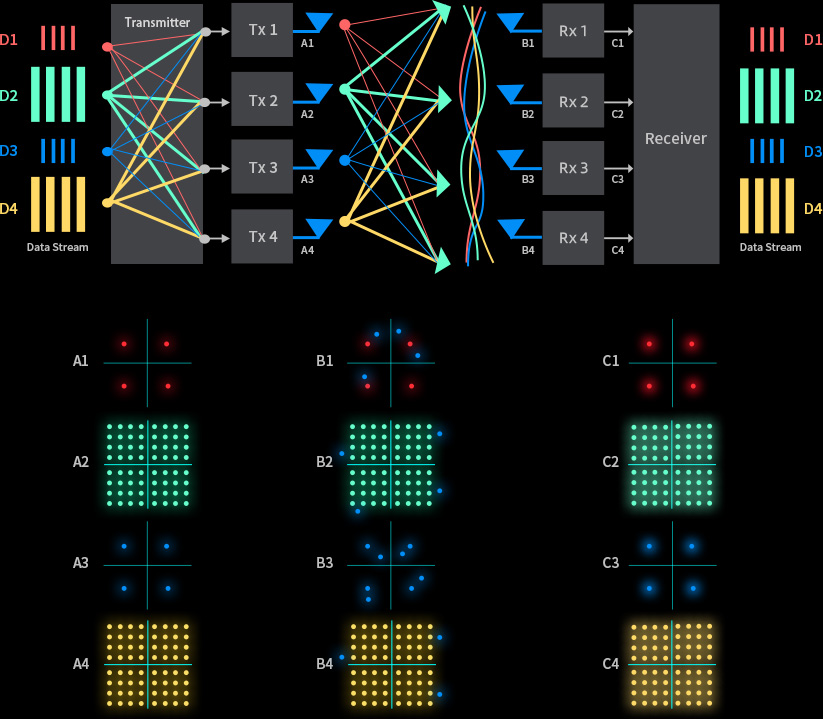
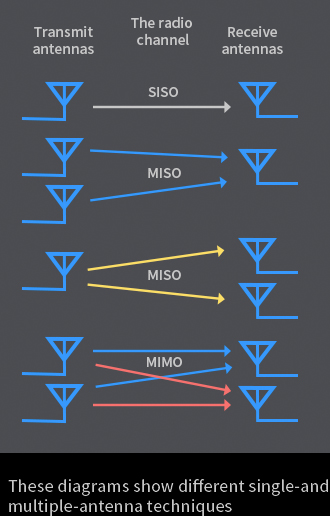
MIMO technology provides both spatial diversity and spatial multiplexing, but there's a trade-off between the two. By properly utilizing both diversity and multiplexing modes in a MIMO system, system gain can be maximized, achieving both reliability and efficiency gains while fully utilizing existing spectrum resources. This comes at the cost of increased processing complexity at both the transmitter and receiver.
MIMO technology and MANET technology are two of the core technologies in current wireless communications systems and are adopted by numerous wireless communication systems.
About IWAVE
For over a decade, IWAVE has been dedicated to the independent research and development of professional-grade wireless communication technologies. By continuously pushing the boundaries of existing technical specifications and continuously iterating its MANET technology framework, the company now possesses a comprehensive portfolio of MANET waveforms with complete independent intellectual property rights, applicable to various fields.
By providing customers with efficient, secure, and decentralized autonomous interconnection communication technologies and products, we empower users with swift, efficient, and smooth comprehensive voice, data, video, and visual command and dispatch capabilities, leveraging the power of Chinese intelligent manufacturing. This allows users to truly achieve "connectivity anytime, anywhere, and at their convenience" in a variety of scenarios.
Post time: Sep-19-2025


